

Non-Residency and Cross Border Rules for South Africans
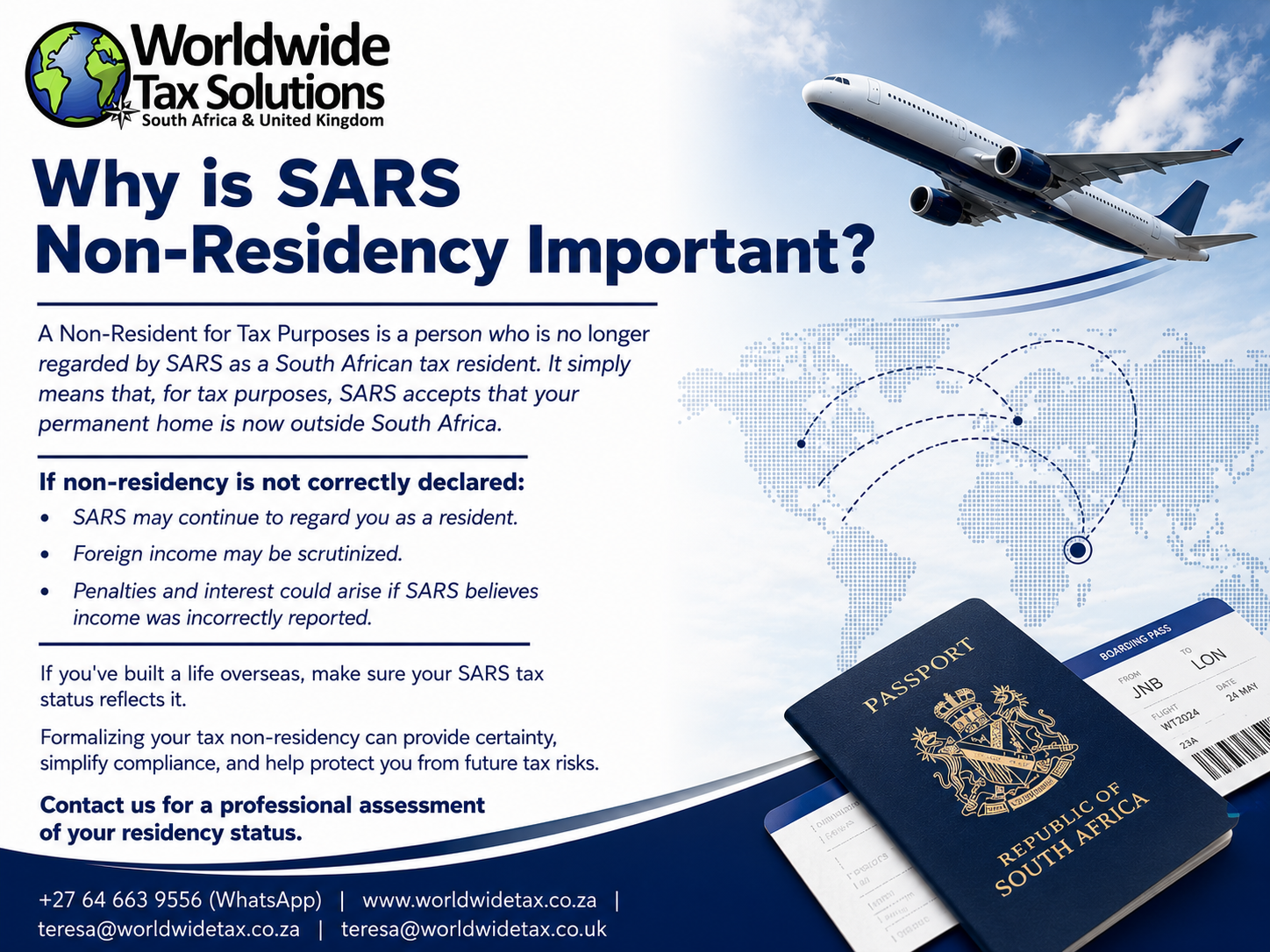
NEW TRAVELLER DECLARATION REQUIREMENT FOR ALL: CITIZENS & TOURISTS
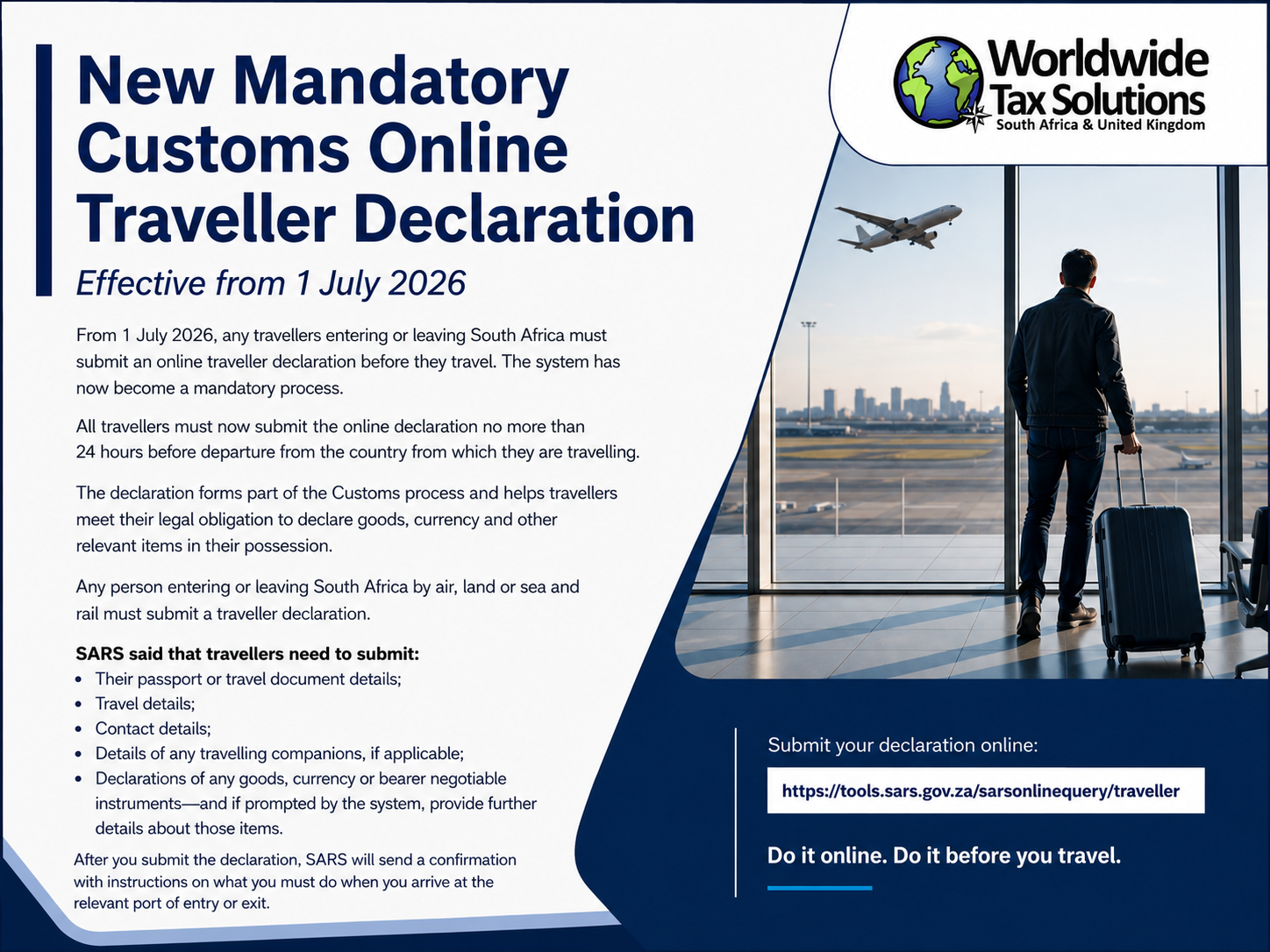
Now Mandatory: The SARS Online Traveller Declaration: What every traveller must do before crossing a South African border from 1 July 2026
If you are flying overseas, driving through a land border or arriving back home from a trip abroad, there is a new step you can no longer skip. From 1 July 2026 the South African Revenue Service (SARS) requires every traveller entering or leaving South Africa to submit an online traveller declaration before they travel. The declaration is submitted through the South African Traveller Management System (SATMS) and replaces the old paper forms that many of you will remember completing at the airport.
The system was piloted on a voluntary basis from 2022. It is now a formal legal requirement under the Customs and Excise Act and it applies at all air, land, sea and rail ports of entry.
Who must complete the declaration?
In short: everyone. The requirement applies to South African citizens, South African residents and foreign travellers alike. Each person travelling must have their own declaration, including children and infants. A parent, legal guardian or another assisting person may submit the declaration on behalf of a minor or a person who cannot complete it themselves.
The only exclusion is for transit passengers. Air or sea travellers who are simply passing through South Africa and who do not leave the designated transit area of the airport or seaport do not need to submit a declaration.
Does it apply to both directions?
Yes. The declaration is required when you leave South Africa and again when you return. It is triggered every time you cross a South African border in either direction. This means a single overseas holiday involves two declarations: one before your outbound trip and one before your journey home.
Domestic flights are not affected. A flight from Durban to Johannesburg involves no port of entry or exit, so no declaration is needed. Equally, the rule is not limited to flights. Land border crossings into neighbouring countries, sea travel and rail travel are all covered.
When must it be submitted?
The declaration must be submitted no more than 24 hours before departure from the country you are travelling from. On your return journey with connecting flights, the declaration must be submitted no more than 24 hours before departure on the final leg directly to South Africa.
If your details change before you pass through Customs, you must update your declaration so the information remains correct.
How to complete the declaration: step by step
The process is quick and can be done on any device with an internet connection. Have your passport, travel details and details of any goods or currency you are carrying ready before you start.
- Access the system. Go to sars.gov.za/travellerdeclaration and click Complete Declaration, or download the SATMS app from your device’s app store. Scan-to-declare QR codes and self-service kiosks are also available at certain ports.
- Capture your traveller details. Enter your personal and identification details, including your passport or travel document information, your contact details and a valid email address. The email address is important because your confirmation is sent there.
- Confirm your travel details. Select whether you are entering or leaving South Africa, choose your port of entry or exit and capture your travel date. If you are travelling on behalf of a business, select the entity option and complete the entity fields.
- Add travelling companions. Add each companion, including children and infants, with their travel document details. Remember that every traveller needs a declaration.
- Declare goods and currency. Indicate whether you have goods, currency or bearer negotiable instruments to declare. If you have nothing to declare, select the nil option. If you do have items to declare, capture the details the system prompts for, such as descriptions, values and for currency the amount, source and reason for carrying it.
- Pay any duties or VAT. Where duties or VAT are payable, these can be paid online before you arrive or at the port by EFT, card or cash.
- Confirm and submit. Tick the declaration to confirm the information is true and correct, complete the CAPTCHA and submit.
- Keep your confirmation. You will receive an email or SMS confirming your declaration together with instructions on what to do at the port. Print it or save it on your phone so you can show it to a Customs officer if requested. Travellers with nothing to declare proceed through the green channel and those with declared goods or excess currency proceed through the red channel.
- What you will need. Passport details, Travel details, Contact details, Details of travel companion, Entity details for business travel
What must actually be declared?
You do not need to declare ordinary personal effects for your own use. You must declare goods and currency that exceed your allowances or that require Customs attention. The key thresholds per traveller are:
| Item | Position |
| Goods up to R5,000 | May be brought in without paying duty or VAT. |
| Goods of R5,000 to R25,000 | A further R20,000 in goods may be allowed but duty and VAT may apply. |
| Goods above R25,000 | Normal Customs duties and VAT apply. |
| Cash and similar instruments above R100,000 | Must be declared through SATMS. These declarations are shared with the Financial Intelligence Centre. |
The duty-free allowance is valid once per person in a 30-day period and does not apply if you return after being away for less than 48 hours.
Practical points worth knowing
- You will not be turned away at the border. SARS has confirmed that travellers will not be denied entry or departure solely because they did not complete the declaration beforehand. Officers and self-service terminals can assist at the port. That said, submitting in advance is the expected process and will save you time in the queue.
- Paper forms are a fallback only. A paper declaration may be used only where there is a SARS systems failure, no internet connectivity or another reasonable ground. The old TC-01 and TRD1 forms have been replaced by the new TD-01 and TGD1 forms.
- Registering goods before you leave. If you are travelling with valuables such as laptops, cameras or jewellery, you may register these with Customs before departure so that you are not questioned about them on your return.
- Commercial goods. Travellers carrying commercial goods that do not qualify under the informal trader provisions must clear those goods on a SAD 500 Customs declaration.
- Foreign registered vehicles. Since 1 June 2026 foreign registered vehicles used by travellers must also be declared on the Traveller Management System.
What this means for you
If you or your family are travelling internationally, build the declaration into your pre-travel checklist alongside your passport and boarding pass. Frequent business travellers, clients working offshore on rotation and clients relocating to or from South Africa should take particular note of the 24-hour submission window and the R100,000 currency threshold.
Once you have completed the South African Traveller Declaration, a confirmation of your declaration will be emailed to you. It will contain instructions of what you need to do once you are at the relevant port of entry, be it a land, sea- or airport.
Labor Inspections of Business in South Africa
The Presidency has outlined a coordinated approach to managing migration with a strong focus on enforcement border security system reform legislative alignment and regional cooperation. Authorities will intensify efforts to identify and deport undocumented foreign nationals while establishing dedicated immigration courts and increasing inspections of businesses that employ undocumented workers. Additional labour inspectors will be recruited and penalties for employers who breach immigration laws will be strengthened to ensure compliance.
Border management will be reinforced through increased funding and the use of advanced technologies such as ground sensors satellite monitoring and drones. Key ports of entry will be upgraded to handle high volumes more efficiently and refugee reception centres will be relocated closer to border posts to improve processing and control.
Within the immigration system there will be a focus on addressing corruption and inefficiencies particularly within Home Affairs.
Plans include developing an intelligent population register using biometric data expanding access to Smart ID cards while phasing out green ID books and extending biometric systems to major airports and busy land borders.
Measures will also be introduced to curb the misuse of Traffic Registration Numbers.
Legislative and policy reforms aim to create a unified legal framework for migration while introducing limits on the employment of foreign nationals. Enforcement against employers hiring undocumented workers will be strengthened and small and informal businesses will be formally registered. Support mechanisms such as the Spaza Shop Fund will be used to promote local enterprise development.
Finally South Africa will work more closely with other African countries to address the root causes of migration including political instability conflict and economic hardship. Collaboration through regional and continental structures such as SADC and the African Union along with bilateral partnerships will be prioritised to improve migration management across the continent.
Smart Tax Planning Tips for the 2026 Filing Season
Effective tax planning is not about last-minute submissions, but rather about making informed decisions throughout the year that legally minimise your tax liability while keeping you fully compliant.
One of the most effective ways to optimise your tax position is by ensuring that you are making full use of all available deductions and allowances.
Contributions to retirement funds remain one of the most tax-efficient strategies, as they not only support long-term financial security but also reduce taxable income within the allowable limits.
Similarly, taxpayers should ensure that all qualifying medical expenses and medical aid contributions are accurately recorded, as these may provide valuable tax credits.
For individuals earning additional income outside of traditional employment, such as freelance or consulting work, it is important to maintain detailed records of all income and related expenses.
Many taxpayers miss out on legitimate deductions simply because they have not retained the necessary supporting documentation.
Keeping organised records throughout the year can make a significant difference at filing time.
Travel allowances and the use of a personal vehicle for business purposes continue to be areas where taxpayers can benefit, provided that a compliant logbook is maintained.
Without proper records, these claims may be disallowed, leading to unnecessary tax exposure.
Provisional taxpayers should pay particular attention to accurate income estimation. Underestimating taxable income can result in penalties and interest, while overestimating may unnecessarily strain cash flow.
Regular reviews during the year can help ensure that provisional payments remain aligned with actual performance.
Another key area to consider is ensuring that your tax affairs are up to date and in good standing with South African Revenue Service (SARS).
Outstanding returns or non-compliance can delay refunds and trigger penalties. Obtaining a tax compliance status pin is increasingly important for financial transactions, including property purchases and business dealings.
Lastly, as global financial transparency continues to increase, taxpayers with offshore investments or income streams must ensure full disclosure.
South Africa participates in international information-sharing agreements, making it essential to declare foreign income and assets correctly to avoid severe penalties.
The 2026 tax season presents an opportunity to take control of your financial position through careful planning and informed decision-making.
Engaging with Worldwide Tax Solutions- we can provide tailored strategies suited to your individual or business circumstances, ensuring both compliance and efficiency.
HMRC NEWS: Making Tax Digital for Income Tax Self Assessment (MTD for ITSA)
The UK government, through HM Revenue & Customs (HMRC), is introducing a new digital reporting system called Making Tax Digital for Income Tax Self Assessment (MTD for ITSA). This reform will significantly change how tax information is reported going forward.
Below is a simple overview of what the changes mean for you.
What is Making Tax Digital (MTD)?
MTD replaces the traditional once-a-year Self Assessment tax return with regular digital updates submitted throughout the year.
Instead of submitting your tax information once annually, the new system requires:
- 4 quarterly updates summarising income and expenses
• 1 End of Period Statement (EOPS) to finalise business accounts
• 1 Final Declaration confirming all income for the year
This means multiple submissions each year instead of a single annual return.
When Do These Rules Start?
The new system will be introduced in stages:
- From 6 April 2026 – Individuals with self-employment or rental income over £50,000
• From 6 April 2027 – Individuals with income over £30,000
• From 6 April 2028 – Individuals with income over £20,000
Income thresholds are based on combined self-employment and property income before expenses.
Who Will Be Affected?
The new rules apply to individuals who earn income from:
- Sole trader businesses
• Self-employment or freelance work
• UK property rentals
• Landlord income
The changes do not currently apply to limited companies or employees with no additional income.
Quarterly Reporting Requirements
Under MTD, you will submit a digital summary of your business every three months. These reports include:
- Total income
• Categorised expenses
• Basic business information
Only summary totals are submitted individual receipts are not sent to HMRC.
Typical reporting periods will be:
- 6 April – 5 July
• 6 July – 5 October
• 6 October – 5 January
• 6 January – 5 April
Year-End Filings Still Required
Even with quarterly updates, a year-end process will still be required.
This includes:
End of Period Statement (EOPS)
Used to finalise profits and apply accounting adjustments.
Final Declaration
This replaces the traditional Self Assessment return and includes:
- Employment income
• Dividends
• Interest
• Other income sources
The final filing deadline remains 31 January after the end of the tax year.
Digital Record-Keeping Will Be Mandatory
Under the new system, HMRC requires businesses to:
- Keep digital accounting records
• Use HMRC-approved software
• Submit reports directly through accounting software
Paper records or manual entry into HMRC will no longer be permitted.
How This May Affect You
For many taxpayers this means:
- More frequent reporting
• Greater reliance on digital bookkeeping
• Improved visibility of your tax position during the year
While this introduces additional reporting, it also allows for more accurate tax planning and fewer surprises at year-end.
How We Are Preparing
Our firm is currently reviewing all client accounts to ensure everyone is prepared well before the new rules take effect.
Over the coming months we will be:
- Identifying clients affected by the new rules
• Transitioning bookkeeping to compliant digital systems where necessary
• Implementing processes for quarterly reporting
• Providing guidance and support to make the transition as smooth as possible
What You Should Do Now
if you are self-employed or earn rental income, we recommend ensuring your records are kept up to date and digitally where possible.
We will contact you directly if your circumstances require changes before the new system begins.
Essential tax tips for new employees in South Africa
Starting your first job is a big deal—new responsibilities, formative learning curves, a paycheck, and, yes, taxes.
So many of us stepping into the workforce for the first time have the same questions buzzing in our heads
When do I need to register for tax after completing my studies?
Once you start earning an income, tax becomes a part of life, but not always right away. In South Africa, you are generally required to register as a taxpayer with Sars (South African Revenue Service) if your taxable income exceeds the annual tax threshold. For the 2025 tax year, this threshold is R95,750 for all those under 65. Remember this figure changes annually, so it’s always a good idea to confirm the latest details on Sars’s website.
If you’ve recently graduated and landed your first job, your employer will usually handle your PAYE (Pay As You Earn) tax registration, deducting the tax directly from your salary. However, if you’re freelancing or completing internships without PAYE, or earning from other sources (like a side hustle), the responsibility to register falls on you. The good news is that it is a straightforward process – just visit Sars’ online platform, eFiling, or a local branch with your ID, proof of address, and bank details. Pro tip: Don’t wait too long to register – late registration can mean penalties if you owe tax.
Do I pay tax on money my family gives me?
If your parents, family, or even close friends are helping you out financially—say, covering rent or giving you a cash boost while you settle into your first job — relax: this isn’t considered taxable income. In South Africa, gifts or personal support from relatives or those close to you fall under the donations tax rules, but there’s an R100,000 annual exemption per donor, and recipients don’t pay tax on it—the donor might if it exceeds that limit. So, if Mom sends you R5,000 a month, you’re in the clear. But here’s the catch: if you invest that money and earn interest or profits, that income could become taxable. To avoid complications, it’s wise to keep clear records distinguishing gifts from earned income, in case Sars requires clarification.
How do I claim medical contributions as a deduction?
Medical expenses can help lower your tax liability if handled correctly. If you’re on a medical aid scheme and you are the main member of that scheme (maybe through your new job), South Africa offers Medical Tax Credits (MTCs). For 2025, these are estimated at R364 per month for the main member, R364 for the first dependent, and R245 for each additional dependent (figures are subject to annual adjustments, so always check the Sars website for updates). These credits reduce your tax bill directly.
To claim them, you’ll need to file a tax return via eFiling once tax season opens (usually in July). Your employer’s IRP5 certificate or your medical aid’s tax certificate will provide the necessary details regarding your contributions; just upload these when prompted. Bonus tip: If you have had significant out-of-pocket medical expenses, like glasses or a hospital stay, you might be eligible to claim additional deductions, but only if they exceed 7.5% of your taxable income for individuals below 65 years old. So, it’s worth consulting a tax expert if this is relevant to you.
What about interest earned as a student?
If you’re a student with savings of R50,000 generating R30,000 in annual interest, here’s how it works: In South Africa, Sars allows you a R23,800 interest exemption if under 65 and R34,500 if over 65. (Remember to confirm the latest figures on Sars’s website). Now, subtract the exemption (R30,000 minus R23,800), which leaves you with R6,200 as taxable interest. If you earned an additional, say R10,000 from a holiday job, your total income would be R40,000. After applying for the exemption, your taxable income would be R16,200 (R40,000 minus R23,800).
However, you only owe tax if your total yearly income exceeds the estimated tax threshold of R95,750 (2025 estimate). Here, R40,000 is below that, so no tax yet—but if your income were to increase, the taxable amount of R16,200 could fall within Sars’s tax brackets. Remember to register on eFiling to report the interest; banks do provide Sars with your earned interest, so it’s crucial to stay transparent!
What is eFiling, and how do I use it?
eFiling is your go-to platform for managing your taxes online—no queuing at a branch is required. It’s where you can submit tax returns, check for refunds, or confirm if you’ve underpaid. Getting started is simple: visit www.sarsefiling.co.za click “Register,” and provide your ID number, email, and some personal details. SARS will verify your account, sometimes by phone or OTP.
Once registered, you’ll submit an ITR12 form each year. This form summarises your income, deductions, and tax credits. Your employer will submit an IRP5 (a document showing your salary and PAYE deductions), to Sars and supply you with a copy of the same. Tax season typically runs from July to November for salaried individuals, and eFiling offers a step-by-step guide through the whole process. If it’s your first time, consider watching a tutorial or asking a friend for help—once you’ve done it, it’s surprisingly straightforward.
What does ‘assessment’ or ‘self-assessment’ mean?
After you submit your tax return, Sars “assesses” it by reviewing your calculations to determine if you’ve underpaid or whether you qualify for a refund. For most new employees, this is automatic: your PAYE contributions already cover most of your tax liability, and eFiling simply confirms it. In some cases, you might receive a refund if too much tax was deducted, or you could owe more if there’s a shortfall.
“Self-assessment,” on the other hand, applies if you’re not on PAYE— for instance if you’re a freelancer or have extra income such as interest from savings. In these scenarios, you calculate your own tax and submit it via eFiling, often with provisional tax payments twice a year (August and February).
Once Sars completes the assessment, they’ll issue an ITA34 notice, called an Original Assessment, summarising the outcome. Be sure to keep it as proof of your tax status – it indicates whether you owe more tax or are due a refund.
Taxes might not be the most thrilling part of starting your first job, but they don’t have to be daunting. From registering with Sars to figuring out eFiling, it’s all about staying on top of what you earn and what you can claim.
Smart ways to legally lower your 2025 tax bill
Here are five key ways to maximize deductions and reduce your tax burden.
- Maximise your Tax-Free Savings Account (TFSA)
Investing in a TFSA is one of the simplest ways to grow your wealth without worrying about taxation. Earnings from these accounts—whether from unit trusts, fixed deposits, or bonds—are entirely tax-free, provided you stay within the limits:
- R36,000 per tax year
- R500,000 lifetime limit
- Contribute to a Retirement Annuity (RA)
Retirement annuities not only secure your future but also offer significant tax deductions. Contributions to pension, provident, and RA funds are tax-deductible up to 27.5% of your taxable income (capped at R350,000 annually). If you have additional cash on hand, topping up your RA can lower your taxable income while building long-term savings.
- Support a Public Benefit Organization (PBO)
Donations to registered non-profits or Public Benefit Organizations (PBOs) can earn you a tax break. SARS allows deductions of up to 10% of your taxable income for contributions to approved charities, covering areas like education, healthcare, and environmental conservation.
- Track your business travel
If you receive a travel allowance, keeping detailed records can significantly reduce your taxable income. SARS allows 80% of this allowance to be tax-free, provided you maintain an accurate travel logbook.
- Join a medical aid scheme
Enrolling in a medical aid plan provides monthly tax credits, reducing your overall tax bill. This applies to the main member and extends to dependents, offering a financial advantage for families.
By taking advantage of these legal tax-saving strategies, you can optimize your finances and reduce your 2025 tax contribution while staying fully compliant with SARS regulations.
Tax compliance in South Africa: SARS’s authority to limit travel
It is well within the powers of the South African Revenue Services (Sars) to limit a taxpayer’s right to travel outside the Republic. A section in the Tax Administration Act (TAA) has a provision whereby a senior Sars official can even require “the taxpayer to surrender his or her passport to Sars”.
Sars invoking certain provisions of the TAA to fulfil its mandate of collecting revenue due to the fiscus serves as a stern warning to non-compliant South African taxpayers—including expatriates, businesspeople, and those who have underestimated Sars. They may find their lives suddenly disrupted as Sars rightfully throws the book at them.
There is a common misconception among wealthy tax dodgers that they will just pack up and leave if Sars finds them. Especially South Africans abroad, including expatriates who left long ago but are still tax residents in South Africa because they have not formally cut ties with Sars, feel a false sense of being able to operate with impunity.
But Sars is not sitting back and is on record that it has the legal authority to discharge its work of collecting all taxes due to the state in an efficient and effective manner: including imposing a travel restriction when deemed necessary. With no passport, you cannot go anywhere before you have paid your taxes.
The TAA also allows for a senior Sars official to follow a process and withdraw a taxpayer’s authorisation to conduct business in the Republic of South Africa. Foreigners are extremely welcome guests in South Africa, provided they follow our rules, including paying their taxes. Where they discard their obligations, Sars has the powers to close their business, with a knock-on effect on any Work or Residency Visas they may hold, as well as their ability to have a South African bank account.
The powers vested in a senior Sars official to “require the taxpayer to cease trading” have significant implications for any business. This underlines that non-compliance when it comes to your tax obligations is not an option.
When taxpayers are hit by these orders, they have a choice between compliance, seeking court relief, or facing a range of legal consequences. The High Court in Pretoria recently ruled that these provisions in the Tax Administration Act are constitutional.
The court also found that the limitations imposed on the taxpayer’s rights were reasonable and justifiable in an open and democratic society, given the importance of tax collection for public interest.
Following the ruling, Sars said: “This precedent-setting decision reaffirms Sars’ legal authority to discharge its work of collecting all revenue due to the state efficiently and effectively. Importantly, the court reiterated that the provisions that allow Sars to determine third-party liability, repatriation of foreign assets, and restrictions of travel are lawful and constitutional.”
What Qualifies as Airbnb Rental Income for Tax Purposes?
Ever wondered how to navigate the complex maze of Airbnb taxes in South Africa without losing your cool? You’re not alone! Many hosts find themselves scratching their heads over tax implications, deductions, and compliance requirements. But fear not, because we’re here to simplify the process and make it as stress-free as possible.
What Qualifies as Airbnb Rental Income for Tax Purposes?
Any income earned from renting out your property on Airbnb constitutes taxable income in South Africa. This includes not only the rental fees paid by guests but also any additional charges, such as cleaning fees or security deposits. It’s crucial to keep meticulous records of all your Airbnb earnings to ensure accurate tax reporting.
Understanding Your Tax Obligations as an Airbnb Host
How is Airbnb taxed in South Africa?
Airbnb income in South Africa is generally considered taxable income. This means that you need to declare your earnings from renting out your property on Airbnb on your tax return.
Here’s a breakdown of the key tax considerations for Airbnb hosts in South Africa:
- Income Tax: All income earned from Airbnb rentals is subject to income tax.
- Value-Added Tax (VAT): If your annual Airbnb income exceeds R1 million, you’re required to register for VAT and charge it to your guests.
- Deductions: You can deduct certain expenses related to your Airbnb property, such as utilities, advertising costs, and property taxes, from your taxable income.
Maximising Deductions to Reduce Your Tax Burden
As an Airbnb host in South Africa, understanding the available deductions can significantly reduce your tax burden. By claiming eligible expenses, you can offset your taxable income and potentially save on your tax payments.
Here’s a breakdown of the most common deductions for South African Airbnb hosts:
Direct Property Expenses
- Levies and rates: These are local government charges imposed on your property.
- Property taxes: The annual tax assessed on your property by the local municipality.
- Homeowners’ insurance: The cost of insuring your property against damage or loss.
- Bond interest: If you have a mortgage on your property, the interest paid on the loan.
- Maintenance and repairs: Expenses incurred to keep your property in good condition.
Operating Expenses
- Utilities: Costs associated with running your property, such as electricity, water, and gas.
- Advertising and marketing: Expenses for promoting your Airbnb listing, including online advertising and marketing materials.
- Cleaning and laundry expenses: Costs for cleaning and laundry services provided to guests.
- Agent’s fees: If you use a property management agent, their fees are deductible.
- Depreciation: Over time, your property may depreciate in value. You can claim a depreciation allowance to offset this decline.
Expenses Directly Related to Rental Income
- Travel expenses: If you travel to your Airbnb property for maintenance, repairs, or guest management, you can claim travel expenses.
- Professional fees: Costs for professional services related to your Airbnb business, such as accounting or legal advice.
Important Considerations:
- Proportional deductions: If you only rent out a portion of your property, you can only claim a proportional amount of the deductions. For example, if you rent out one bedroom in a three-bedroom house, you can only deduct one-third of the utilities and other expenses.
- Record-keeping: To substantiate your deductions, it’s essential to keep detailed records of all expenses. This includes receipts, invoices, and bank statements.
Partial Property Rentals and Proportionate Deductions
If you’re renting out only a portion of your property on Airbnb, such as a single room or a guest house, it’s important to understand how this affects your tax obligations. When you rent out a part of your property, you can only claim deductions that are directly related to that portion.
Here’s a breakdown of how proportionate deductions work:
- Determine the rental income: Calculate the total rental income you earn from the portion of the property you’re renting out.
- Calculate the total expenses: Determine the total expenses associated with the entire property, including utilities, maintenance, and other relevant costs.
- Calculate the proportion: Divide the rental income from the rented portion by the total rental income from the entire property. This will give you the proportion of expenses that can be deducted.
- Apply the proportion: Multiply the total expenses by the proportion calculated in step 3. This will determine the amount of expenses you can deduct for the rented portion.
Example:
If you have a three-bedroom house and rent out one bedroom for R3,000 per month, while the other two bedrooms are occupied by family members, your total rental income is R3,000. If the total expenses for the entire house are R5,000 per month, you can deduct R1,000 (R3,000 / R5,000 * R5,000) for the rented portion.
Additional Considerations:
- Shared expenses: If you share expenses with the family members occupying the other rooms, such as utilities or internet, you may need to allocate a portion of these expenses to the rented portion.
- Record-keeping: Maintain detailed records of your rental income and expenses to accurately calculate proportionate deductions.
Keeping Accurate Records: The Cornerstone of Tax Compliance
Maintaining detailed records is crucial for ensuring accurate tax reporting and avoiding penalties. By meticulously tracking your income and expenses, you can provide the South African Revenue Service (SARS) with the necessary documentation to substantiate your tax claims.
Here’s a checklist of essential records for Airbnb hosts:
- Rental income records:
- Reservation details, including guest names, check-in/check-out dates, and rental periods.
- Payment receipts or bank statements showing the amounts received.
- Any additional fees collected, such as cleaning fees or security deposits.
- Expense records:
- Receipts or invoices for all deductible expenses, including utilities, property taxes, maintenance, and advertising.
- Bank statements showing payments made for expenses.
- Property ownership documents:
- Proof of ownership, such as a title deed or lease agreement.
- Property tax assessment notices.
- Rental agreements:
- Copies of rental agreements for each guest.
- Calendar or diary:
- A record of your activities related to your Airbnb property, such as maintenance, guest interactions, or property inspections.
Tips for effective record-keeping:
- Use accounting software: Consider using accounting software specifically designed for rental properties to streamline the record-keeping process.
- Scan and digitise documents: Store digital copies of your documents for easy access and backup.
- Organise your records: Create a filing system to store your documents in a logical and easily accessible manner.
- Keep records for at least five years: The South African Revenue Service generally requires you to keep records for five years after the end of the tax year.
By maintaining accurate records, you can:
- Ensure accurate tax reporting: Provide SARS with the necessary documentation to substantiate your tax claims.
- Avoid penalties: Minimise the risk of penalties and interest charges if you’re audited.
- Support your deductions: Provide evidence to support your claims for deductions.
- Track your income and expenses: Gain insights into the profitability of your Airbnb business.
Remember, thorough record-keeping is not only a legal requirement but also a valuable tool for managing your Airbnb business effectively.
Consequences of Non-Compliance
Failing to declare your Airbnb income or neglecting to register for VAT when applicable can result in hefty penalties and even criminal prosecution. The South African Revenue Service (SARS) has the authority to audit your tax returns and impose penalties for non-compliance.
Additional Considerations for South African Airbnb Hosts
- Tax implications for foreign residents: If you’re a foreign resident renting out a property on Airbnb in South Africa, you may be subject to different tax rules. It’s advisable to consult with a tax professional specialising in foreign income.
- Staying informed about tax law changes: Tax regulations can evolve over time. Staying updated on the latest tax laws pertaining to Airbnb rentals ensures you remain compliant.
Navigating Airbnb Taxes with Confidence
Understanding your tax obligations and implementing effective record-keeping practices are essential for Airbnb hosts in South Africa. By doing so, you can ensure compliance with tax laws and maximise your deductions.
Key points to remember:
- Airbnb income is generally taxable: All income earned from renting out your property on Airbnb is subject to income tax.
- VAT registration: If your annual Airbnb income exceeds R1 million, you’re required to register for Value-Added Tax (VAT).
- Deductions: You can deduct certain expenses related to your Airbnb property, such as utilities, advertising, and property taxes.
- Record-keeping: Maintaining accurate records of your income and expenses is crucial for tax compliance.
Consulting with a qualified tax professional is highly recommended to:
- Get personalised advice: Ensure that you’re adhering to the latest tax laws and regulations.
- Maximise deductions: Identify all eligible deductions to reduce your tax liability.
- Avoid penalties: Minimise the risk of penalties and interest charges for non-compliance.
By taking these steps, you can confidently navigate the tax landscape as an Airbnb host in South Africa and maximise your financial returns.
Understanding and managing Airbnb taxes in South Africa is crucial for hosts to ensure compliance and maximise their rental income. By staying informed about income tax obligations, VAT registration requirements, and available deductions, you can navigate the complex tax landscape with confidence. Remember these key points:
- All Airbnb income is generally taxable in South Africa.
2. VAT registration is required if your annual Airbnb income exceeds R1 million.
3. Meticulous record-keeping is essential for accurate tax reporting and maximizing deductions.
4. Proportionate deductions apply when renting out only a portion of your property.
5. Non-compliance can result in severe penalties and legal consequences.
