
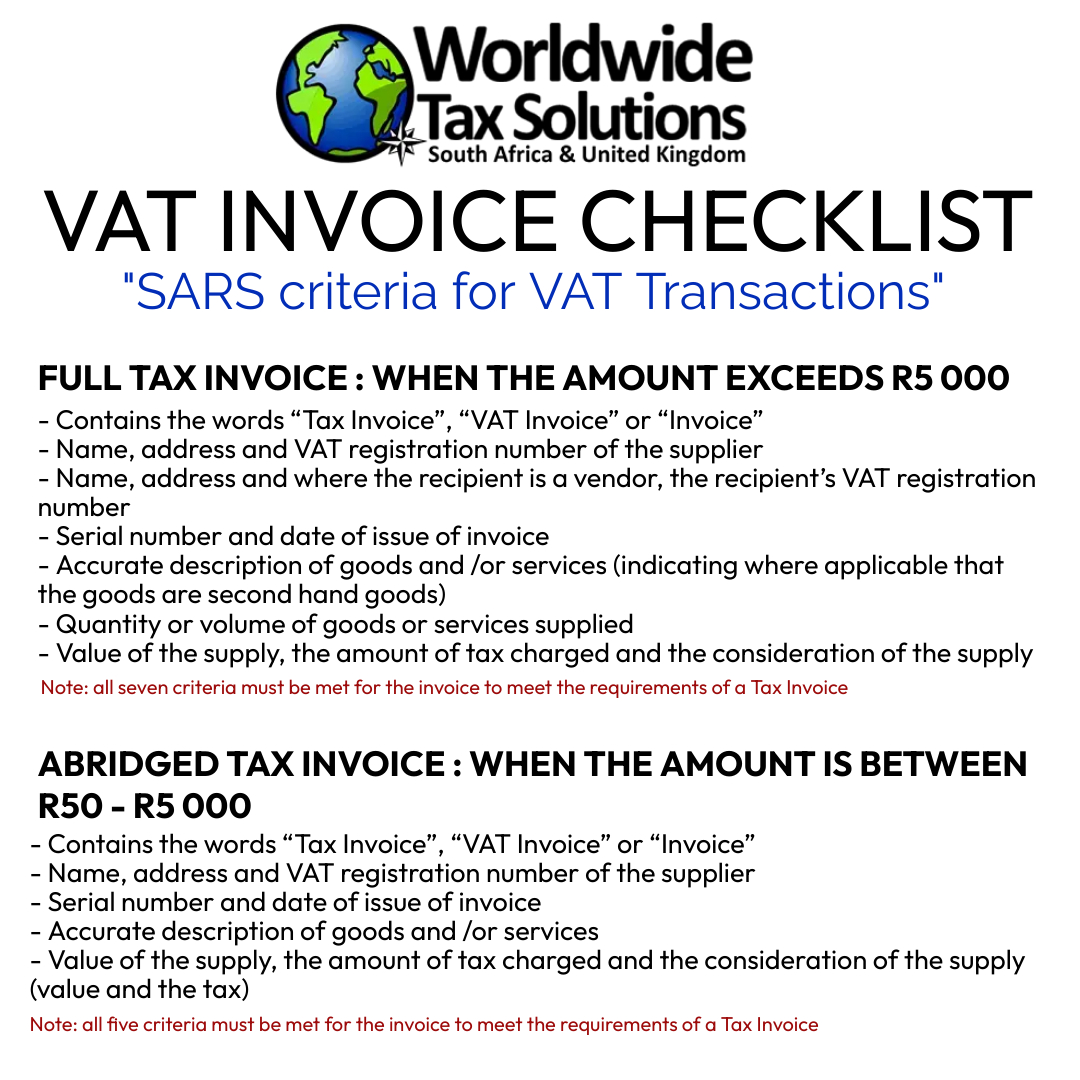
Donations Checklist – Applies to all Section 18a PBO Organisations
EXCITING NEWS!
Congratulations to our Director, Teresa Seaton, on being chosen as a SAIT Regional representative for the KwaZulu-Natal region. We are very proud of you! 🎉🏆

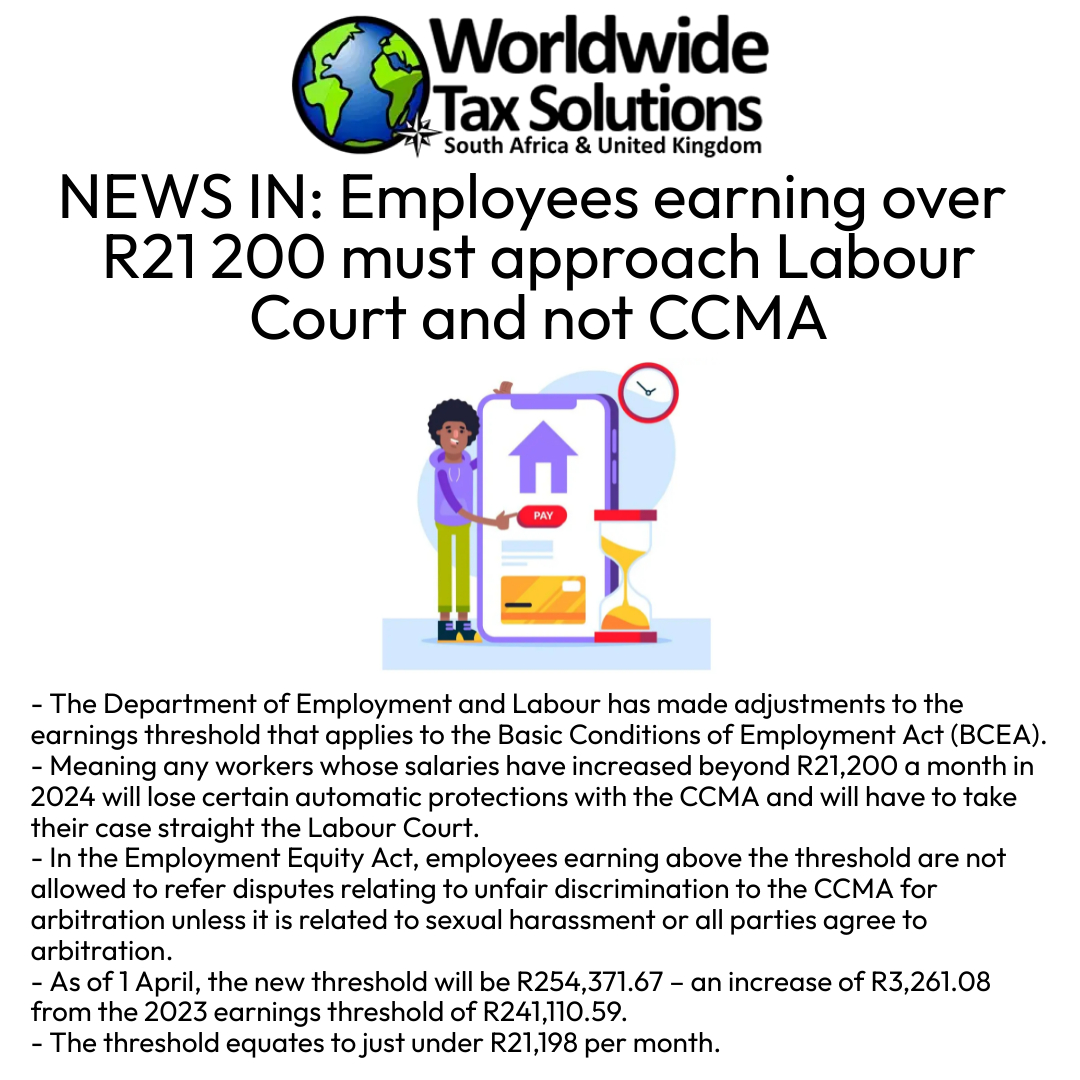
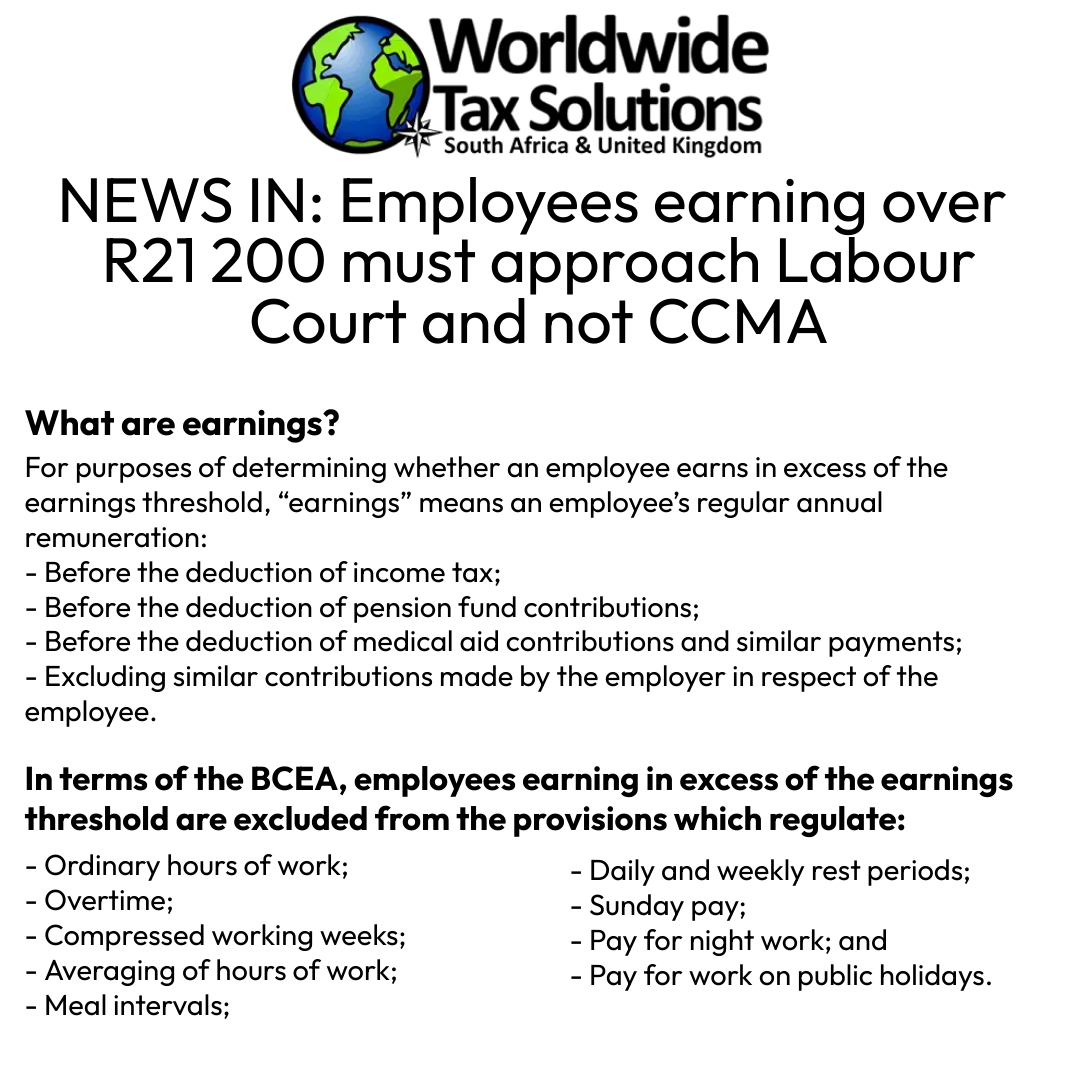
CCMA Rules change for Employees who earn more than R21 200
UNDERSTANDING SARS DISPUTES
The Office of the Tax Ombud dealing with SARS Disputes
The Office of the Tax Ombud (OTO) came to the rescue in a matter between the South African Revenue Service (Sars) and a taxpayer, ‘saving’ the taxpayer more than R500 000.
The taxpayer approached the OTO with its complaint when the objection it raised against an assessment was invalidated, preventing the taxpayer from lodging an appeal against the decision.
The dispute arose from a 2023 assessment in which Sars disallowed a claim for the tax exemption on income earned abroad.
The taxpayer objected and submitted supporting documentation for the claim.
Sars requested additional supporting documents, and the taxpayer obliged.
Sars did give reasons for rejecting the objection, and indicated that the taxpayer could submit a new notice of objection.
Following the invalidation of the objection, the taxpayer lodged a complaint with the OTO.
The OTO considered the matter and recommended that Sars withdraw the rejection and take a decision on the objection.
Sars adhered to the recommendation, allowed the dispute, and reduced the assessment by more than R500 000.
Sars can invalidate an objection if:
- The taxpayer does not set out the grounds of the objection in detail;
- The taxpayer does not use eFiling and does not specify the address where Sars can communicate with the taxpayer;
- The form is not signed or if the representative is not authorised to represent the taxpayer; or
- The objection is lodged more than 30 days after the date of the assessment.
There was no error in the objection; therefore, there was no defect to correct in a new notice of objection.
Sars’s reasons for the invalidation of the objection indicate that it had, in fact, considered the grounds of the objection and, thereby, the merits of the dispute.
It is thus evident that the reasons Sars gave for the invalidation of the objection fall outside the dispute resolution rules.
In the appeal process, alternative dispute resolution can be followed where the taxpayer and Sars meet to find a faster, less expensive solution.
The OTO notes that Sars is not allowed to invalidate an objection because it disagrees with the taxpayer’s grounds of dispute.
If Sars requests further supporting documentation – as it did in this case – it must decide to allow, disallow, or partially allow the objection based on the information submitted by the taxpayer.
Objections are “invalidly invalidated” more often than we would like to see. Although it is happening less frequently, it is still happening.
The 2020 Tax Ombud’s Systemic Investigations Report concluded that there was a 31% error rate where objections were incorrectly invalidated for various reasons.
There is no updated data to confirm whether the situation has improved or worsened.
If the objection is disallowed or partially allowed, the taxpayer can resubmit the objection to amend the non-compliance, or approach the OTO, as in this case, or the tax court to have it validated.
If Sars invalidates an objection, there is always something that can be corrected when submitting a new objection.
The taxpayer can submit the correct form, or properly set out the grounds for the objection, sign the form and supply an address if not using eFiling to address the non-compliance.
Generally, but not always, when Sars invalidates an objection, and you cannot address the reason for the invalidation in the next objection, it is an indication that the objection was invalidly invalidated.
National Treasury referred to the alternative dispute resolution proceedings during this year’s budget, noting that it can only be accessed at the appeal stage of a tax dispute.

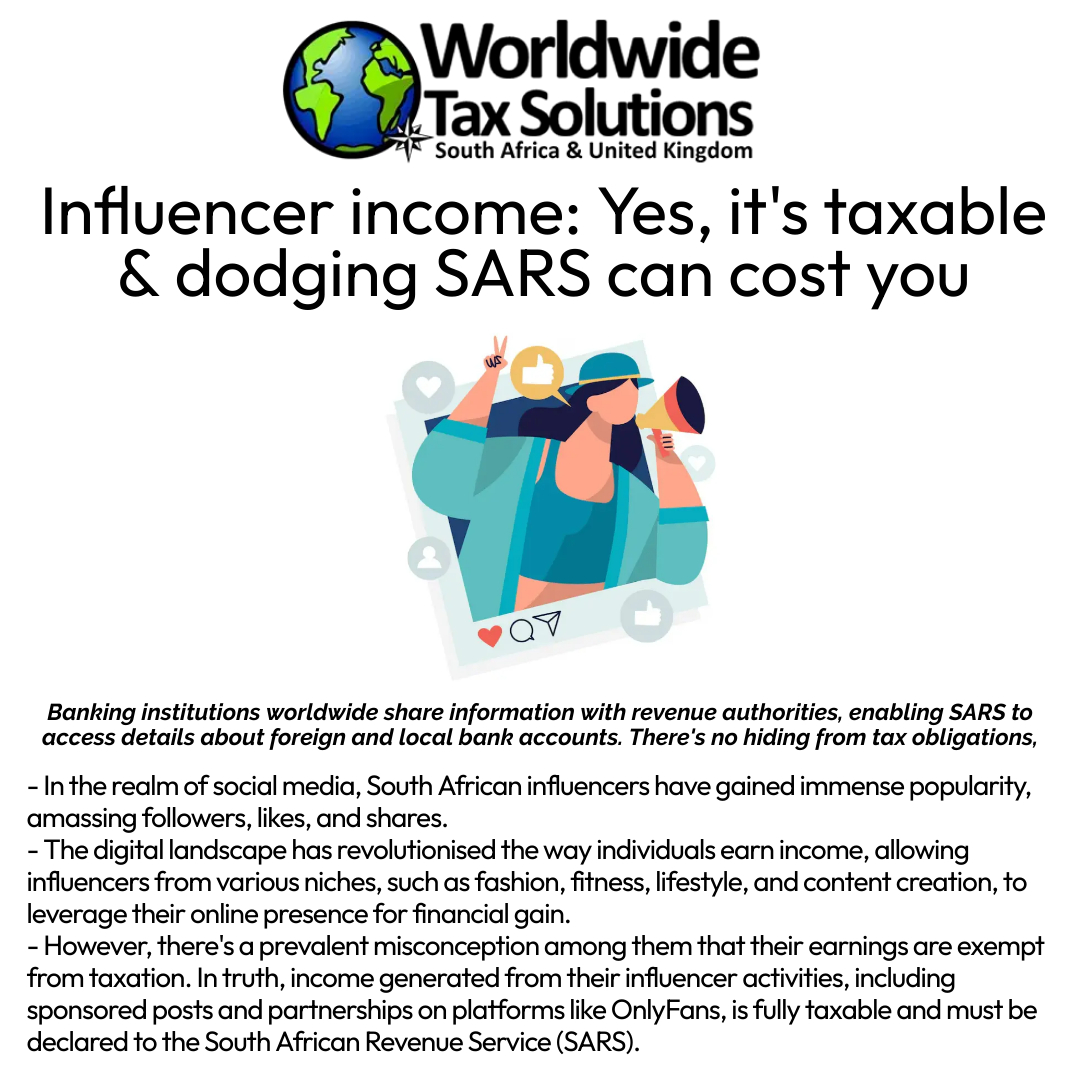
Tax Obligations for Influencers
Income generated from influencer activities, including sponsored posts and partnerships on platforms is fully taxable and must be declared to the South African Revenue Service (SARS).

Dormant companies & the De-registration Process
What is a dormant company
A dormant company is classified as a company that has not actively traded for the full year of assessment.
Because there is no activity in the company, it’s easy to forget about it completely along with all red tape that goes with it.
Penalties
SARS have recently become a lot stricter about levying administrative penalties for non-submission and late submission of company tax returns (even if the company is dormant) and these penalties will continue to re-occur on a monthly basis until the submission of the tax returns.
So, if you’re director of a company or the public officer of a dormant company, you still have a duty to submit the company’s tax returns to SARS.
- Check with the Companies and Intellectual Property Commission (CIPC) to see which companies are registered on your name and identity number.
- You can also see here if the company is dormant or still active according to their records.
- Check on SARS eFiling to see if there are any outstanding tax returns for this company.
- Submit all outstanding tax returns to SARS and request the Tax Compliance Status.
De-register a company
When a company de-registers with the Companies and Intellectual Property Commission (CIPC), it implies the company is no longer registered and has no legal standing since it’s not doing any business nor has any assets or liabilities.
When a company de-registers with SARS, it will have no further tax obligations.
If you don’t intend to trade through your company, it would be advisable to de-register with both CIPC and SARS as soon as possible to avoid further administrative penalties.
What is Turnover Tax?
Turnover tax is a simplified system aimed at making it easier for micro business to meet their tax obligations.
The turnover tax system replaces Income Tax, VAT, Provisional Tax, Capital Gains Tax and Dividends Tax for micro businesses with a qualifying annual turnover of R 1 million or less.
A micro business that is registered for turnover tax can, however, elect to remain in the VAT system
Turnover tax is worked out by applying a tax rate to the taxable turnover of a micro business.

Who is it for?
Micro businesses with an annual turnover of R 1 million or less. The following taxpayers may qualify:
- Individuals (sole proprietors)
- Partnerships
- Close corporations
- Companies
- Co-operatives
How to register?
To register for Turnover Tax:
- Do a quick test to see if you qualify for turnover tax
What records should be kept?
A big advantage of turnover tax is the reduced record-keeping requirements.
The following records must be kept:
- Records of all amounts received;
- Records of dividends declared;
- A list of each asset with a cost price of more than R10,000 at the end of the year of assessment as well as of liabilities exceeding R10,000.
To take account of the typical expenses incurred by a micro business and to eliminate the need for detailed recordkeeping of deductible tax expenses, the turnover tax rates are significantly lower than the tax rates under the standard tax system.
What is Small Business Corporation Taxes?
Small businesses with an annual turnover of up to R20 million may qualify to pay Income Tax at a reduced tax rate.
A Small Business Corporation (SBC) is a private company that complies with various requirements per the Tax Act.
If it meets the definition of a SBC, it can take advantage of progressive tax tables (as opposed to the fixed standard corporate tax rate) and also accelerated depreciation for certain assets.
The latter means that less tax may be paid in the early years when the assets are purchased.
If you indicate that you are a small business on your Income Tax Return (ITR14), and meet all the requirements, the reduced rates will be applied automatically.
There is no need to apply for the reduced rates because your SBC status will be determined using information on your ITR14.

Is your business viewed as a Small Business Corporation by SARS?
Is your business Turnover less that R20 million per year?
Are the shareholders in your business all natural persons?
Do you only own your one business?
Does less that 20% of your turnover come from “investment” income?
Is less than 20% of your income from rendering a “personal” service?
If you have answered YES to all the above questions your business could be making massive Income Tax savings.
Personal service includes any service in the field of accounting, actuarial science, architecture, auctioneering, auditing, broadcasting, consulting, draughtsman ship, education, engineering, financial service broking, health, information technology, journalism, law, management, real estate broking, research, sport, surveying, translation, valuation or veterinary science, performed personally by any person who holds an interest in the company, close corporation or co-operative, except where such small business corporation employs three or more unconnected full-time employees for core operations throughout the year of assessment.
2024 UK Spring Budget Highlights 🇬🇧


