
VAT Invoice Checklist – Compulsory for VAT Vendors

2024 TAX SEASON IS HERE!

CIPC Important Notice regarding the Beneficial Ownership Application [All your FAQ’s addressed]


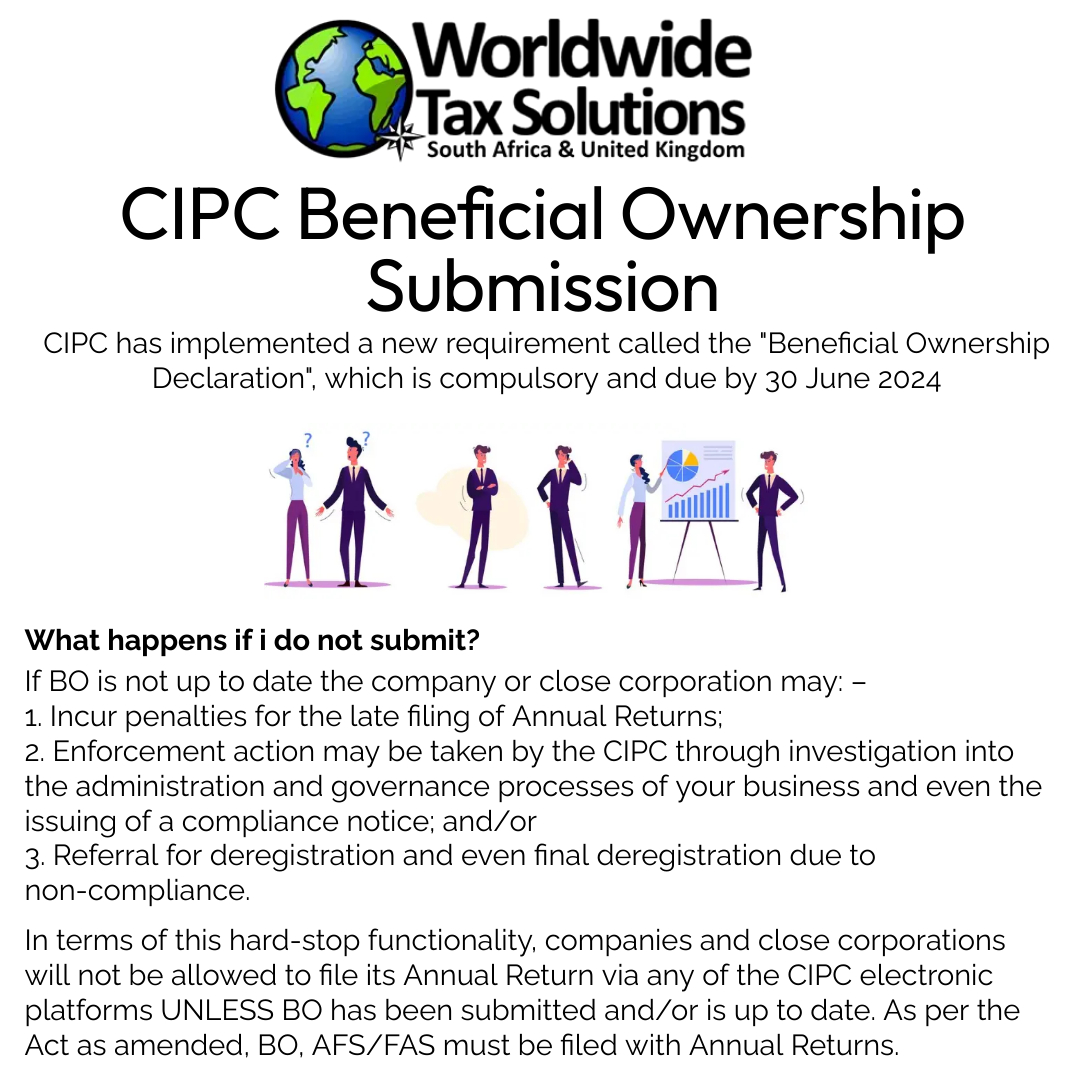
SARS announces its Focus Areas for the 2024/2025 Fiscal Year
SARS is coming after company directors

SARS is targeting the directors of companies who fail to submit their tax returns.
The move forms part of SARS’s broader strategy to combat tax evasion and ensure that all corporate entities and their directors meet their tax obligations.
The agency previously relied heavily on administrative penalties and audits to encourage compliance.
However, the persistence of intentional non-compliance among some company directors has necessitated more drastic measures be implemented.
This new enforcement strategy aims to hold individuals vicariously accountable for the financial management of their companies, as directors have a fiduciary duty to ensure that their companies comply with tax laws.
Failure to do so not only undermine a healthy tax ecosystem but also places an unfair burden on compliant taxpayers.
Under South African law, it is a criminal offence for company directors to not submit their corporate income tax returns and those pertaining to payroll taxes and VAT.
The Tax Administration Act means that directors who fail to ensure the timely submission of their companies’ returns will face major penalties, such as fines and, in some instances, imprisonment.
The criminal summonses issued by SARS indicate the beginning of legal proceedings that could lead to prosecution.
If found guilty, directors could face imprisonment of up to two years per successful conviction of any criminal offence related to non-compliance.
Several high-profile cases involving directors have already occurred.
Public reaction to SARS’ compliance crusade has been mixed, however, many taxpayers and advocacy groups have welcomed the move, viewing it as a necessary step to ensure just and equitable treatment within the framework of our tax system.
They argue that stringent enforcement against non-compliant directors will deter others from similar misconduct and ultimately enhance the integrity of the tax regime.
However, some business leaders have expressed concerns about the potential for overreach and the impact on business operations. They urge SARS to balance enforcement with support, providing more guidance and resources to help companies in voluntarily meeting their tax obligations.
SARS’s issuance of criminal summonses is part of a broader initiative to strengthen tax compliance in South Africa, with the agency deploying its data analytics capabilities to identify non-compliant taxpayers efficiently and deploying more resources to audits
The agency has also been enhancing its data analytics capabilities to more effectively identify non-compliant taxpayers and deploy more resources to its audit and investigation teams.
That said, Commissioner Kieswetter has reiterated that while enforcement is necessary, SARS will engage with the business community to promote voluntary compliance.
SARS has indicated on many occasions that it aims to make compliance easy and cost-effective while making non-compliance difficult and costly.
SARS keeping an eye on international travel and high-end vehicles

The South African Revenue Service is desperate to extract as much money as possible from taxpayers, and the nefarious activities are in the taxman’s firing line.
Although many taxpayers expect minor repercussions such as fines and interest charges, a new protection strategy, with the help of the Hawks, South African Police Service (SAPS), and the National Prosecuting Authority (NPA), is becoming more aggressive over non-compliance.
Amid mounting pressure on tax collections and non-compliance, the entity is actively targeting taxpayers who fail to disclose their taxable income accurately.
The taxman’s efforts have resulted in record tax collection figures, with collecting R2.155 trillion in tax revenue for the fiscal year ended March – R10 billion more than the Treasury had even predicted.
One reason for the increase was the 8% growth in personal income tax (R651 billion), with SARS making a concerted effort to target citizens who avoid their tax obligations or do not submit their returns correctly under the willful non-compliance category.
The revenue office relies on personal information, AI and machine learning algorithms to identify and flag non-compliant taxpayers.
SARS looks at flight activity (such as frequent international travel) and luxury purchases (such as high-end vehicles or luxury vacations) and could execute a luxury audit to verify if an individual displays a lifestyle that does not match the tax return.
Through its specialist High Wealth Individual Unit and the Specialized Audit Unit, SARS has managed to achieve record tax revenue.
We have seen in recent reports of individuals being arrested and imprisoned, which is a serious warning that being non-compliant is a very dangerous place to be.
Over the 2023/24 fiscal years, SARS was successful in 94 of the 110 cases that were handed down, an 84% litigation success rate.
SARS offers a Voluntary Disclosure Programme (VDP) to individuals, companies, or trusts to voluntarily disclose and resolve their tax matters, as long as they are not under or expecting an audit or investigation from SARS or have reached a request for inflation from SARS.
Proactively rectifying tax defaults not only brings compliance relief but also significantly lowers the risk of penalties and legal repercussions.
AI enhancements: 2024 filing season

The South African Revenue Service (SARS) is fighting a war on non-compliance, and taxpayers shouldn’t think that they can hide any information from the taxman.
Individual taxpayers, provisional and non-provisional, will be able to file their annual tax returns from 15 July 2024.
With the enhanced efficiency propelled by SARS’ use of Artificial Intelligence (AI) data-driven compliance insights, “Open Season” on non-compliant taxpayers is year-round, but Filing Season presents a unique opportunity for SARS’ expert marksmen to step up.
Despite the examples of the rich flouting tax laws and ending up in jail, the average Joe should also keep in mind that they can end up in the same hot water.
The average person may not know that they have stepped on the wrong side of SARS’s war on non-compliance, with section 234 of the Tax Administration Act providing a list of actions and inactions which constitute criminal offences.
This list includes acts committed based on an absence of tax literacy, such as retaining specific documentary items or issuing an incomplete document to SARS.
On the flip side, failure to commit acts, such as the submission of a tax return or notifying SARS of a change in registered particulars, may also result in criminal charges being laid against you.
Whilst the listed offences range from the obvious, such as pretending to be a SARS official, to the seemingly unassuming, such as submitting erroneous statements to SARS, they all carry a liability, upon conviction, of a fine or a maximum prison sentence of 2 years.
Low- and medium-income earners often believe that they hide information from SARS, but the revenue service likely knows more about your finances than your family does.
SARS also has multilateral engagements, with automatic information exchanges with revenue collection agencies worldwide.
Although this information gathering capability has been tried and tested, the issue was a lack of manpower to effectively process and prosecute those guilty parties – the solution is SARS’ pilot AI project.
This AI capacity-bolstering technique has already been seen across SARS’ historic audit processes, where it is used to maintain thoroughness and accuracy while deriving data-driven insights almost instantaneously.
This move underscores a broader trend towards the integration of technology in tax administration, promising to revolutionize the way tax compliance is monitored and enforced.
If one finds themselves in SARS’s crosshairs over non-compliance, it is crucial that they make a timely response to SARS with all the correct supporting documentation.
Those who fail this first hurdle will also have made an incorrect disclosure to SARS. They will feel additional pressure when additional assessments are raised, or final demands are received for overdue tax debts.
The nail in the coffin is always the Understatement Penalties, capping at a bank-breaking 200% of the capital taxes due.
Medical Aid and Tax Deductions

The tax season dates are not yet announced. However, based on prior years, they are expected to be the following:
01 July 2024 to 23 October 2024: individual (non-provisional) taxpayers
01 July 2024 to 24 January 2025: provisional taxpayers
Here are the top 5 reasons why you should not skip filing your tax return this season:
- You miss out on your refund.
A refund is money you overpaid on your taxes and it belongs to you. You can only get a refund if you file a return. Something as simple as claiming Medical expenses or working for less than 12 months of the tax year can trigger a tax refund, depending on your situation.
- You may not be able to borrow money.
If you wish to borrow money in the form of a mortgage for a home, or a long-term loan of any kind in future, you may need a Tax Compliance Certificate. This can only be obtained if all your returns are up to date and filed appropriately.
- SARS might change their mind.
If you normally submit, but this year you don’t, SARS could administer administrative penalties later on down the line for not being compliant, and no one wants that!
- You can’t access your retirement fund.
Filing a tax return each and every year means that should you receive a payout from a fund at any stage, then you will not have any hassle in getting the money. If you retire or are retrenched, or just need to take money out of your fund early, you need to be tax compliant.
- A complete tax record stands in your favor.
Having an unbroken filing record leaves SARS officials with no reason to suspect that you are hiding information from them. Filing a tax return means you are being a good citizen and contributing towards society.
Medical Expenses
If you contribute to a Medical Aid, you will receive a fixed monthly tax credit for each member on your policy. SARS calls this rebate the Medical Schemes Fees Tax Credit – it is a flat rate per month (i.e. it doesn’t take your taxable income into consideration) and is a direct deduction off your tax liability. Note that the tax credit applies only to registered medical aid funds – medical insurance or GAP cover does not count.
Make sure that you have a tax certificate from your medical aid provider as support for this tax credit. They generally send these out on email before filing season opens.
If you have ‘qualifying’ medical expenses, which were not reimbursed by the medical aid, you should also include these in your tax return because you may qualify for an ‘additional medical expenses tax credit’. Qualifying medical expenses includes all consultations with medical practitioners as well as doctor prescribed medication. SARS applies a complicated formula to work out whether you spent enough to qualify for an ‘additional medical expenses tax credit’.
Remember to ensure you have proof for every single medical expense you paid for over and above your medical aid cover with invoices and / or detailed receipts.
Your medical scheme provider is supposed to send your tax certificate to you by email or post by July, but if they have not done so, you can ask for it directly.
A tax credit is a non-refundable rebate. This means that a portion of your qualifying expenses, in this case medical related spend, is converted to a tax credit, which is deducted from your overall tax liability (the amount of tax you have to pay SARS). You can’t carry any unused credit over to the next tax year and it won’t ever result in a negative amount or standalone refund from SARS.
This means that if you don’t earn an income, but do contribute a medical aid, you can’t claim the medical credit.
Who SARS Considers as Dependents for Medical Expense Claims
SARS sees the following as dependents:
- A spouse (husband or wife)
- A child and the child of a spouse (e.g. son, daughter, stepchild or children, adopted child or children) who was alive during any part of the year of assessment, and provided that on the last day of the year of assessment he / she was unmarried and:
- a minor, i.e. under the age of 18, or
- under 21 years of age, but partly or entirely dependent on you for maintenance and not yet liable for normal tax themselves, or
- under 26 years of age, but partly or entirely dependent on you for maintenance, not yet liable to pay normal tax themselves and a full-time student at a publicly recognized educational institution such as a university or Technikon
- Any other member of your family who relies on you for family care and support (e.g. mother, father, sibling, mother or father-in-law, grandparent or grandchildren)
- Any other person recognized as a dependent in terms of the rules of a medical scheme or fund
- Proof of above payments will be required to claim the medical expenses if the dependent is not directly on your medical aid, however you do pay for their medical expenses
What are Qualifying Medical Expenses for Tax?
Examples of qualifying medical expenses are any amounts that were paid by you, as the taxpayer, during the year of assessment:
- For professional services rendered and medicines supplied by a registered medical practitioner, dentist, optometrist, homeopath, naturopath, osteopath, herbalist, physiotherapist, chiropractor or orthopedist to you or any of your dependent(s)
- To a nursing home or hospital, or any duly registered or enrolled nurse, midwife or nursing assistant (or to any nursing agency in respect of the services of such a nurse, midwife or nursing assistant) in respect of the illness or confinement of the person or any dependent of the person
- For medicines prescribed by a registered medical practitioner and acquired from a pharmacist
- Medical expenses incurred and paid outside South Africa
- It’s important to note that “over the counter” medicines – such as cough syrups, headache tablets or vitamins don’t qualify as medical expenses – unless specifically prescribed by a registered medical practitioner and acquired from a pharmacist.
SARS is strict on the definition of a qualifying disability. According to the Income Tax Act, a disability is:
A moderate to severe limitation of that person’s ability to function or perform daily activities, as a result of a physical, sensory, communication, intellectual or mental impairment if the limitation:
- Has lasted or has a prognosis of lasting more than a year; and
- Is diagnosed by a duly registered medical practitioner in accordance with the criteria prescribed by the Commissioner
In order to benefit from the full disability-related medical expenses provisions, you’ll need to have an ITR-DD (confirmation of diagnosis of disability form for an individual taxpayer) form completed by a registered medical practitioner.
Click on this link https://www.sars.gov.za/wp-content/uploads/SARS_ITR-DD_PD_E_v2023.13.00.pdf or email us at teresa@worldwidetax.co.uk for a copy of this form
What supporting documents do I need for SARS?
If you do claim medical credits as a result of paying medical aid for a dependent, where you are not the main member of the medical scheme, then it is almost certain that SARS will audit you. In this case, be sure you have the following:
- The medical aid tax certificate in the financial dependent’s name,
- Proof of payment to the medical aid (bank statements for that tax year)
- Letter explaining why this dependent is currently financially relying on you. (Please find below letter template)
Medical Aid contributions paid on behalf of a dependent
If you are claiming medical aid tax rebates on your personal return, but you are not the main member on the medical aid, we will need below related form completed and returned with your 2024 tax documents. You are only allowed to claim the medical aid tax rebates provided no one else is claiming this on their own returns.
Date
Taxpayer’s Full Name
Address
To Whom It May Concern,
Subject: medical aid contributions paid on behalf of a dependant
This letter serves to confirm that I, ________________________(taxpayer’s full name), __________________________(ID number) am contributing to a medical aid on behalf of _______________________________(name of dependant),___________________(ID number). He/she is/is not financially dependent on me and I am currently financially assisting due to: ________________________________________________________
I have been making medical aid contributions on behalf of my dependant for the following months:
_______________________________
Monthly contributions: R_________
Total annual contributions: R_________
Tax year: __________
Please see proof of payments attached.
______________________
Name
Relationship status e.g. Father
Telephone
Email
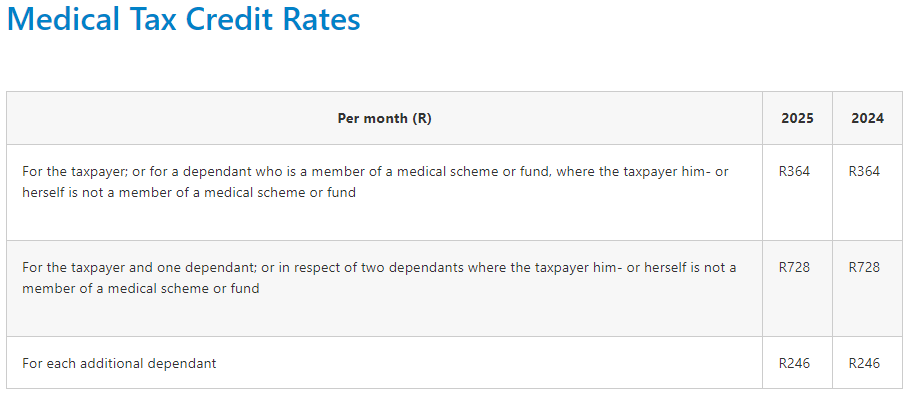
Medical Aid Monthly Rebates:
How to get your money out of South Africa

Many South Africans find themselves considering opportunities abroad, but moving their funds abroad can be a confusing process.
A comprehensive understanding of ceasing tax residency and exchange control regulations is essential in moving abroad.
Financial emigration is the formal process for relocating abroad permanently, and it requires obtaining a non-resident tax status letter from the South African Revenue Service (SARS).
South Africa’s tax system is residence-based, meaning residents pay taxes on global income.
Transitioning to non-resident tax status involves formal declaration to SARS and ongoing compliance with tax and exchange control regulations.
The SARS notice confirms cessation of tax residency and specifies the date.
Once deemed a non-resident for tax purposes, individuals are only required to declare and pay taxes on income earned within South Africa and adhere to regulatory requirements set forth by SARS and exchange control authorities.
In addition, South Africans emigrating need to be cognisant of South Africa’s exchange control regulations, overseen by the South African Reserve Bank (SARB).
These regulations are crucial for managing capital flows in and out of the country.
The following has to be considered in terms of the nation’s exchange control regulations:
- Changing tax residency status requires corresponding adjustments to banking status as per SARB mandates. When one is no longer a tax resident in South Africa, individuals must update their banking status by converting bank accounts to non-tax resident status.
- All transfers are subject to exchange control approval and clearance by the SARS. Transferring South African assets upon ceasing tax residency may not be straightforward. For instance, cashing out retirement policies after maintaining non-tax resident status for at least three consecutive years necessitates the authorized dealer verifying the source and available Tax Compliance Status (TCS) PIN.
- The treatment of fund transfers depends on the nature of funds, whether classified as capital or income. For those transferring proceeds from capital assets sale, they need to provide an AIT TCS PIN from SARS to authorized dealers.
South African residents can transfer up to R1 million out of South Africa annually through their Single Discretionary Allowance (SDA) without SARS’s clearance.
Anything above the limit will require an Approval International Transfer (AIT) TCS PIN from SARS.
Non-residents, on the other hand, can transfer up to R1 million as a Non-Resident Travel Allowance (TA) in the year in which they formally cease tax residency.
However, this is a one-time allowance and cannot be used in the following years.
Moreover, individuals can no longer be eligible to make use of the SDA when tax residency is ceased.
Therefore, all capital transfers out of South Africa, except for specific exceptions, need SARS approval through means of obtaining an AIT TCS PIN.
It is important to distinguish between TA and SDA, as any remaining SDA balance can’t be used under TA.
For any transfers exceeding R10 million, approval from the Financial Surveillance Department of SARB is additionally required.
This triggers a comprehensive Risk Management Test, including tax status verification, assessment of funds’ source, and compliance with anti-money laundering and counter-terrorism financing requirements.
You can follow us on our for live updates
Link:
